Monday, 6 October 2014

Beaker Daggers

Beaker Culture gets its name from the Bell Beaker Pottery that accompanied its spread across parts of Europe. However Beaker Culture wasn't just limited to a trade of ceramics, among other things a similarity in weapons, art and to some extent religion can be found in the places where Beaker Culture gained a foothold.

In Britain the Bell Beaker usage was short lived and the Beaker period is most associated with the construction of Stonehenge and the spreading of metallurgy. The period may also have been accompanied by some form of human migration such as foreign experts (metallurgists and potters) who arrived in Britain to sell and eventually teach their new fangled skills to the British. The most famous example being the Amesbury Archer whose grave was found near Stonehenge and seems to be a metallurgists from the Alps near Austria, who made his fortune in Britain.

Beaker Daggers 
Notched kite shaped Beaker Dagger, found in London
Prior to the Beaker period large knives did not exist in Britain. Knives seem mostly to have been functional cutting tools for making things and butchering with. The appearance of Beaker Period Daggers marks arguably the peak of British stone technology however the reason for their appearance remains illusive. Beaker Daggers are rarely found, which could suggest they were of extremely high value so few made. Alternatively the reason could be the problem of finding a suitably large and high quality piece of flint to make them from, which would only be available in limited parts of the country. Another reason for their rarity could simply be due to the difficulty of the manufacturing process, which would have required substantial practice by knappers wasting whole nodules of flint in each attempt to perfect the skill to make them, making them economically unviable. The daggers have been seen as an attempt by knappers to compete with the new metal technology, perhaps this competition was a futile exercise that never took off or they were something quite apart from the metal daggers and any comparison misguided.

Un-notched leaf Beaker Dagger found in London
Beaker Daggers ranged in size from 5" to 8" inches but 7" to 7.5" seems the be the preferred size. Many were leaf shaped, some reached maximum width near the middle while others were kite shaped. From about halfway down the flint was shaped into a tang for hafting. Tangs varied in width, some thinning a lot while other being nearly as wide as the blade. Some dagger were notched on the tang, to aid hafting, while others weren't. The diversity of shape and design of the daggers is quite wide and individual knappers put their own style on them.


When I began knapping ten years ago my ultimate aim was to be able to make Beakers Daggers. It was a long journey, perfecting my skills and learning to make a plethora of other (easier) things along the way, but Beaker Dagger were always the ultimate aim.

This is the second batch of commercial daggers I have made, last year's batch now sold out. All were made with copper except the second from left which was made with stone and antler.

I made this video I musing about the possible uses of the stone daggers.


Wednesday, 17 September 2014

Tuesday, 12 August 2014

Brandon Gun Flint Knapping

Some videos I made from old films and uploaded onto youtube. These show the last days of the Brandon gun flint industry. Brandon knappers were the last professional knappers in the world.


By the late 18th the main weaponry of all major European armies was the flintlock, keeping them firing depended on a large and reliable supply of gun flints being at hand at all times. Countries maintained large peacetime stockpiles of gun flints but these quickly dwindled during wartime and a large efficient industry was needed to maintain the supply to the troops. In doing this each European country was faced with unique problems, such as  flint supply, flint quality and manufacture method. Supply was a major headache for a country which had limited supply or no supply of flint as it would need to import from other countries, effecting the nation's foreign policy and leaving it open to embargo during wartime. Flint quality was a problem which could effect the troops on the battlefield and the outcome of battles if guns misfired. Finally manufacture method was important as nations at war would require millions of gunflints to be supplied each year for the duration of the war and if the production method was inefficient supplies could falter.

Prussia for example was a country with no flint, however it did have a limited number of agate mines. These mines were owned by the state and heavily guarded, attempts to remove agate from them by the public was a capital offence. The agate was worked slowly and inefficiently by grinding the agate with heavy stone wheels however the quality of gun flints when made was high. On the other hand France with abundant quantities of high quality flint relied on small artisan shops to make gunflints for them. They used a method known as the French Method which had managed to independently redevelop prehistoric blade core technology and was not only fast and efficient but produced the best quality gunflints in the world.

The British landscape so widely covered in flint had spawned a gunflint industry spread across half the country, frequently near ports or naval bases. English gunflints were often made from poor quality flint and by the slow and inefficient English Method. This was until 1792 when to improve the standards of British gun flint making the whole industry was moved to the small Suffolk town of Brandon, which was situated not far from Grimes Graves and near one of the highest quality mines in the world. In additional to having access to the best flint the English Method of knapping was abandoned and a modified French Method adopted. The modification of the French method was to use a square hammer and block instead of a round one in the final stages of production which allowed the production of three gun flints from a single flake instead of one, making the manufacture rate almost three times as fast as the French.

After the Napoleonic Wars thanks to flint quantity, quality and manufacture speed, Brandon was to gain a monopoly on the world's gun flint supply. However with the peace after 1815 and invention of the percussion cap in 1822, this monopoly was of small comfort as the industry spent the next century in perpetual decline and the life of a knapper one of poverty. In periods of peace the Knappers produced flint in such high quantities that the market was oversupplied and prices rock bottom. Even in times of war when one of the few countries still using gun flints would place an order, such as Turkey during the Crimean War, the production method was so efficient the several million flints in the order was met by just a single small workshop.

In the 1860s with the discovery by archaeology and geology of the 'Antiquity of Man', and the realisation that the stone objects being dug up out of the ground were not peculiar quirks of nature but man made tools, interest in Brandon and its ailing gunflint industry was revitalised. As archaeologists struggled to work out what stone objects dug from the ground were natural, what were man made and how they were made, Brandon provided the last professional flint workers in the world to help answer this question. Brandon for the next half century was to attract archaeologists, journalists, collectors, tourists and cranks in equal measure.

with the need for military gun flints all but exhausted by the late 19th century Brandon didn't die but instead adapted to modern times. Brandon Knappers constantly innovated new wares to sell such as prehistoric reproductions, creative new flint novelties devised by themselves such as jewelry, ornaments and decorations, one knapper even advertised in Australian newspapers offering to reproduce Aboriginal artefacts. They also found work from the construction industry producing flint bricks and wall facings. Brandon survived to the 20th century and the last Brandon knapper died in the 1980s continuing to make gun flints for black powder enthusiasts and reenactment groups till his death.


Friday, 14 March 2014

Barbed and Tanged Arrowhead Guide

This free guide explains the varieties of Barbed and Tanged arrowheads found in Britain during the Neolithic and Early Bronze Age. A high resolution version and more free posters can be downloaded from the site below.


Wednesday, 5 March 2014

Flint Knapping Tools

Antler Billets (long, short & heavy), antler set in antler pressure flaker, thin antler tine in wood pressure flaker, long and short pointed antler tines for pressure flaking.

The tools used by flint knappers both today and in the past is one of the most hotly debated areas of the art. The only definite thing that can be said is every knapper today has his/her unique preferences, some knappers prefer to keep it simple having just a few favourite tools they have mastered while other carry tool boxes of specialist utensils, some knappers prefer to knap ‘Paleo’ using only what they believe people in the past used while other knappers embrace modern technology, some knappers buy their tools preferring ones from specific shops who all make their tools slightly differently, while others custom make their own coming up with original twists and takes. Some knapper even construct elaborate contraptions such as jigs to knapping machines. The sheer variety of tools and techniques modern knappers have come up with makes the case knappers of the past would have done it very creatively too so no hard an fast views of how people in the past knapped or what tools they used can be formed. 

Click here to view a range of modern knapping tools made in the UK

Today we are still not entirely sure what tools ancient knappers used and how they used them. Archaeological finds have revealed to us many tools that were used, lithic analyses and experimental archaeology have suggested even more, but this doesn't seem to be the whole pictured as many artefacts are still unreplicatable by modern knappers, and many that have been successfully replicated have only been done so with custom made tools that lay outside the archaeological record. There have been discoveries of knapping tools  we don’t know the use for, archaeological digs have uncovered tools that would have been very useful for knapping, but not in clear enough context to say they definitely were part of a knapper’s tool kit, also first hand descriptions of prehistoric knappers by people such as the Conquistadors suggest the way tools were actually used is very different from some modern methods.

Flint knapping has been around for 2.6 million years and done globally, so it is not surprising there was a lot of variety in what was made, how it was made and what was used to make it, for example one stalwart of man made knapping tools throughout much of the world is the deer antler, however in several parts of the world such as Australia and parts of South America, antlered or horned animals simply do not exist, so alternative tools had to be found.

(Left; Flint Knapper's Kit? Discovered during Heathrow Terminal 5 excavation) 8 Arrowheads, 5 Flint Tools, Whetstone, Copper Awl.

At the moment modern knapping seems dominated by one very limited area of knapping, biface production, and two methods of lithic reduction, direct percussion and pressure flaking and the tools most conducive to doing this the most commonly mastered by modern knappers. Which has lead them to continue to use these methods when experimenting in other areas such as making blade cores. Such a limited style of knapping and tools use in no-way reflects the majority of knapping done in prehistory, the main methods used or the tools used. 

Direct Percussion is the main method of knapping used today, basically is hammering. The piece of flint is hit with a hammer, some varieties of which are called billets and boppers. The first kind ofthis tool is a hard hammer, in prehistoric times these were stones and possibly pieces of copper, in modern times stone, copper, aluminium and iron/steel is used. Copper is the most limited of these usually being made into a billet and replicating the effect of a very hard hammer stone, iron/steel hammers used in the gunflint, strike-a-light and brick making industries are much more specialised and come in various weights and shapes such as pointed, rounded, flat ect. Hammer stones though offer the most flexible option in range of sizes, shapes and weights but most importantly textures and hardness. Being able to switch between hard stones such as chert pebbles to soft stone such as limestone offer a knapper a greater flexibility than modern tools, though they take a longer time to master.

Hard tools are used in the early stages production to remove large pieces of the flint, when the flint is suitably reduced softer hammers need to be used so not to break the flint and also because they enable longer thinner flakes to be removed. Prehistorically deer antler billets were a favourite for this but also wooden ones. Many modern knappers use moose antler billets which are heavier and more dense than deer antler, however none have ever been found in the archaeological record so it is a point of contention how authentic something made with one of these is. Other traditional tools suggested are copper, bone and ivory. Modern knappers tend to use a copper bopper and occasionally aluminium ones, technically hard not soft percussion, they perform similarly to antlers, are much quicker to master and much cheaper, last a lot longer and require little maintenance unlike antler which need constant maintenance. 

A less common method of knapping used in modern times is indirect percussion, this is where a hammer and punch are used to remove flakes. Antler or wooden billets being commonly used for the hammers and antler for the punches. 

 (Left: Copper Boppers and Copper Pressure Flaker, made and sold by Prehistorics Shop)

Pressure flaking, a lot of prehistoric pressure flaking was done with an antler tine while most modern pressure flaking is done with a pressure flaker. Pressure flakers were used in prehistoric times though. Pressure flakers are short sticks with either and antler tine tip, wooden tip, copper or iron/steel nail inserted into it. Otzi the Ice Man was found to have an antler tipped pressure flaker on him when his body was discovered in the Alps, also in Peru a pressure flaker with a wooden tip was recently dug up. Longer pressure flakers are known as Ishi sticks were used by the American Indians and even longer ones with copper tips were used by the Egyptians,  copper has also been found on tools in Europe though the exact tool type is unconfirmed. Iron/steel nails is a very recent addition made by modern knappers, but were also adopted by Australian Aboriginals and American Indians after contact, so technically prehistoric, iron/steel working better on obsidian and glass and making notching a lot easier. Another suggested insert for pressure flakers is animals incisors, these can be large predator's down to rats, a set of rat's incisors were found alongside some knapped objects in the US.


Saturday, 7 September 2013

In Search of Britain’s First Knife

In Search of Britain’s First Knife


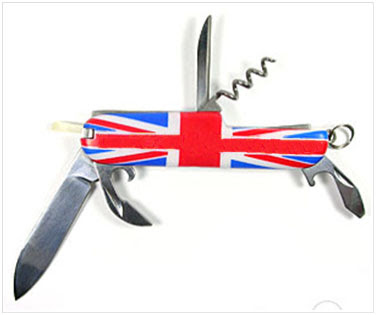
Knives are a diverse species of objet d’art straddling such extremes from the minute bladed craft knife to the rugged Bowie knife, from the hodgepodge that is the Swiss Army Knife to the grim shape of a Kukri, they come in all shapes and sizes from switchblade to carving knife, can be curved, straight bladed, pointed or snub nosed, they can be made of metal, plastic, ceramics, even bamboo and used for cutting, stabbing, throwing, chopping, as a ornament, a status symbol or even in a religious ceremony. So setting out too find the first British knife may not be as straightforward a task as it at first seems, especially when we throw in a huge philosophical discussion on what actually constitutes a knife in the first place. Taking this on board the search for Britain’s first knife is going to be more a journey by the scenic route of prehistoric knif-ish development rather than a concise answer. 

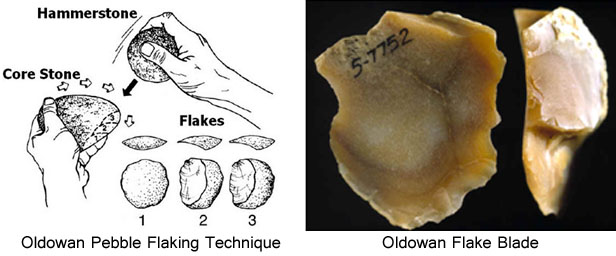
Oldowan Flake Tools
Our story starts when a species of monkeys got bored just hanging around in trees and had delusions of grandeur deciding to kick start the whole technological process that one day would lead to splitting the atom and Justin Beiber CD’s. It was about 2.6 million years ago in Oldawan Gorge in Tanzania when the diminutive Homo Hablis hominid species, the aptly named ‘handy man’, one of man’s earliest ancestors made humanity’s first cutting blade by striking a flake off a flint pebble and creating the first knife-like object.


These first flake blades are about as crude as it comes but they were used for cutting the raison d'etre of a knife, so could the search be over already? The first flint blades found in Britain date back over 800,000 years. They were created by an unknown people and so sketchy is our knowledge of these very first Britons even what Hominid species they were is unknown. It’s ironic in many ways living in a country which prides itself on its contribution to science and technology that it has an extensive ban in place on knives, the very item it was man’s desire for that created this whole technology thingy that the modern world is a malaise of in the first place. 

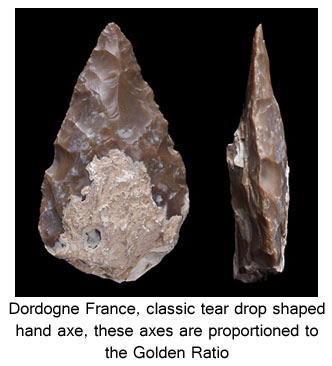
Acheulean Hand Axes
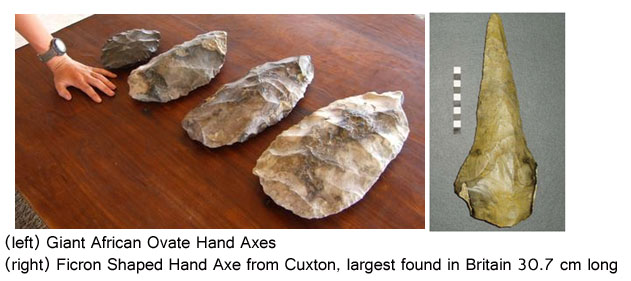
Around 1.7 million years ago a new knife-like tool appeared on the bloc, the magnificent Acheulean Hand Axe, arguably the most inaccurately described thing in history, at least until Ed Miliband described himself as a Socialist that is. Called a ‘hand axe’ the tool was a cutting implement and although varying enormously in shape and size all designs have the quality of having long continuous cutting edges. The Acheulean Hand Axe would continue to be manufactured on and off for a million and a half years giving is the longest use in human existence of any tool and any tool manufactured for that long must have many merits. 

While Acheulean hand axes were most likely butchery knives, the mysteries, quirks and out of the box theories you would expect that surround a tool this distant in time and with this longevity are abound. Up until the 18th century hand axes were called thunderbolts and when found in the ground believed to be the tip of a lightning strike. One of the more quirky modern archaeological theories of their use is they were hunting Frisbees thrown at the legs of running animals to bring them down. Hand axe’s size also differ greatly making interesting theorising as in many countries giant handaxes were made, in Britain the largest found is 307mm long. The complete ludicrousness of the size of some hand axes making them impossible to wield show there must have been more than a purely functional use for them, was it art, religion? One archaeologist suggests that is was phallic, the size of the hand axe representing the size of the manhood of the owner, unsurprising the said archaeologist who came up with this interpretation is female and she married a man who drove a 4 by 4. One of the more tangible mysteries of these items though is the phenomena of burying large quantities of unused hand axes together, for religious reasons perhaps? In Britain the Acheulean industry occurred in several locations, most famously Boxgrove around 500,000 years ago and the culprit the unfortunately named Homo Heidelbergensis.

Lithic Core Blades
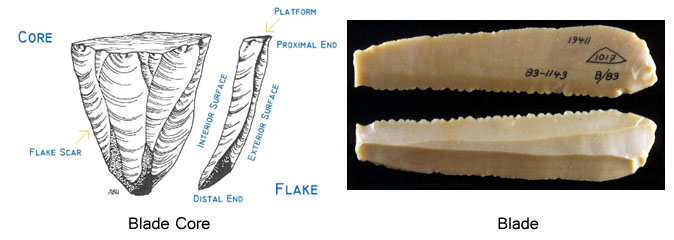
Another strong candidate would be Lithic Core Blades, these are even called blade knives. These blades are high tech and are created by the systemic removal of long straight blades from prepared flint cores. It is a highly skilled technique dating back possibly as far as 200,000 years ago and was still use by gun flint knappers in England in the twentieth century. Blade cores were used the world over and the blades from these cores were the staple tool of many prehistoric societies being razor sharp and manufacturable in seconds. They would have been used for all tasks imagineable from cutting meat and vegetables to making cloth or even agriculture, the abundant blades would simply be used for a few minutes until blunt, thrown away and another one grabbed. They were the world’s first completely disposable tool. 


The technique for making these blades is best described as bloody difficult to do but is extremely ergonomic aswell as virtually the whole flint nodule can be turned into blades with little wastage. Blade core technology proves that Britian did once actually have an efficient industry, just you have to go back two hundred thousand years to find it.

An excellent film of a Brandon knapper making these blades can be seen here.
http://www.youtube.com/watch?v=HgLCXkOv-bc

Microliths

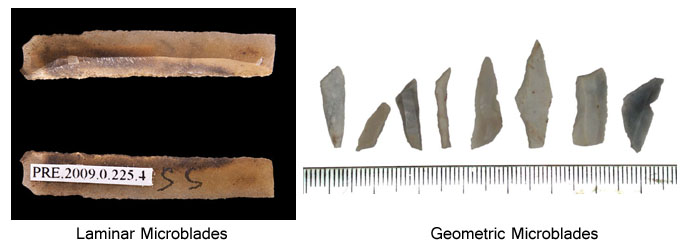
Microliths is a name given to a whole miniature tool kit and includes knife style blades. Being called micro it doesn’t take a degree in linguistics to work out these blades are extremely small however if you regard a doctors scalpel as a knife it would be hard to say these minute scalpel like implements aren’t knives too. 

Microliths first appeared around 30,000 years ago in China, when they arrived in Britain is more sketchy, they may have made it before the Dimlington Stadial but they definitely arrived after it during the Mesolithic era where they became the whole basis of technology in Britain for millennia. There are two kinds of microliths, the older Laminar ones which are simple straight blades and later geometric shaped ones. 

Discoidal knives

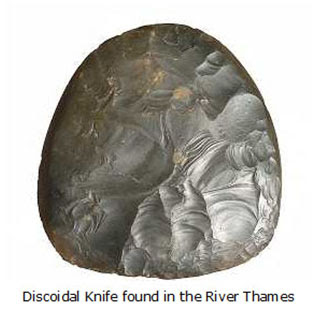
After thousands of years of using microliths people in Britain finally went bugger it they’re too fiddly and concluded they needed something they could get their fingers around, a more sensible design of knife, naturally they came up with a circular one.

Discoidal knives were manufactured in Britain during the Neolithic Era, the rather odd shape does have some logic to it honest! It gives it the longest possible cutting edge possible and as it blunted could just be rotated. Also resharpening would be easier than with a straight blade. 

Plano Convex Knives

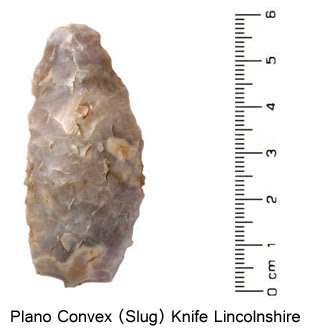
Plano convex knives or ‘slug knives’ are an especially British knife appearing in the late Neolithic. Plano Convex means flat on one side and rounded on the other. They were manufacture from Blade Core Blades, the inner flat side of the blade being left unknapped and the outer ridged edge being flaked over, this basically made the blade eco friendly as the blades were resharpenable and didn’t need to be disposed of after one use. Slug knives then were officially the beginning of the green movement in Britain and shortly after green and black top bins became common outside all roundhouses. 


Beaker Daggers
With the coming of the Bronze Age stone technology died...... No actually it didn’t, it boomed, you see metal at first was only available to a few people, the super rich or people good at plundering things from the super rich. Knappers got brand new tools kit including metal tools which improved their knapping quality skyward and a whole lot of custom orders flooded in from the middle classes who couldn’t afford shiny metal things so wanted decent flint imitations.

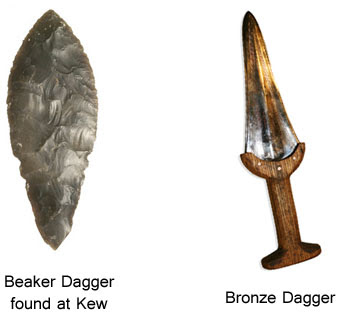
Beaker Daggers were the finest flint knives ever produced in Britain and clearly and indisputably knives. The only problem is they first appeared in the Bronze Age and seem to be imitations of copper or bronze knives. This would rather surreally mean stone technology post dated metal technology. 

Beaker daggers are large usually 7-8 inches on average and were hafted with wooden handled similar to the ones bronze and copper knives had. They vary in design but seem to be very wide at the tip and designed for cutting not stabbing, it’s unlikely their use was as a weapon if they even had a use at all beyond that of status symbol.

Non-Conclusion
I set out to discover what Britain’s first knife and have travelled through 2.6 million years in order to do so. Somewhere along the line Britain’s first knife has revealed itself, the question is where? I would guess different readers will have their own views, so I offer no conclusion to this article but instead a question, which is Britain's first knife?

Saturday, 4 May 2013

British Neolithic Arrowheads Video

This video is made as a follow up to last month's post explaining the seven main types of arrowheads found in Britain during the Neolithic Era.

These arrowheads were made for our...........  Arrowhead Set Range.

Set contains one of each king and come in a display box. Other sets are also available featuring different kinds of arrowheads.